

TRVV Family Drag Chain Cables: The Complete Model Guide
The TRVV family is the classic drag chain range — the flexible PVC cables that most machine tools, handling equipment and production lines actually run. It holds 3,043 standard constructions in our cable selector: TRV, TRVV, TRVVP and TRVVSP. This guide explains the whole family: how to read a model code, what each member is, and which one fits your chain.
1. What the TRVV family is
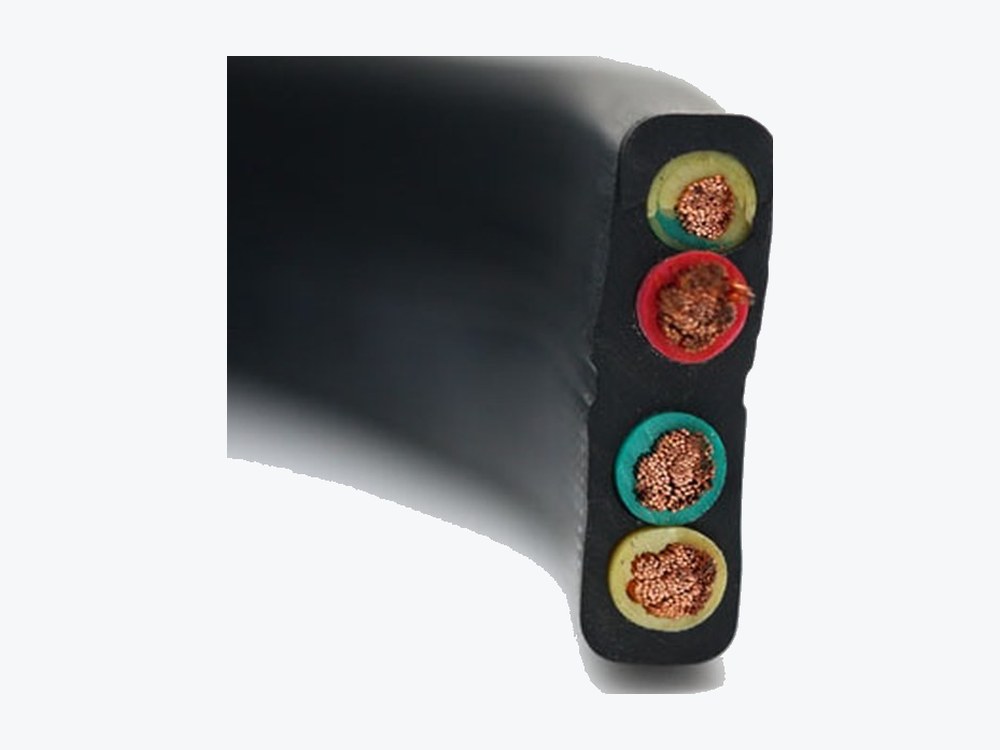
The family is built on one flexible platform: fine-stranded oxygen-free copper conductors (0.08/0.1 mm strands), tinned or bare, with a flexible special-polymer insulation and jacket, in black, grey, orange or green. Rated voltage is 300/500 V, 450/750 V or 600/1000 V by construction, and the standard range runs 1.5–50 mm², with conductor sizes up to 300 mm² producible. The base product is our High-Flex Power Cable, and the selector below it lists the full TRVV grid — 1,220 standard constructions: multi-core builds of 2–40 cores × 0.10–35 mm², power builds and single-core builds up to 240 mm².
Everything else in the family is a variation on that base: add a braided shield, twist the cores into pairs, add a second sheath, or strip the sheath away entirely. The model code tells you which — once you can read it, you can read the whole range. The full comparison of the three shielding grades is in our guide to TRVV vs TRVVP vs TRVVSP.
3,043 standard constructions: TRV 40 + TRVV 1,220 + TRVVP 1,483 + TRVVSP 300. Every one of them is listed in our cable selector with its stock code, construction, outer diameter and weight — the numbers in this guide are recomputed from that selector, not from a catalogue summary.
2. How to read a TRVV model code
The model names are construction codes. Each letter adds one fact about the build:
| Letter | Meaning | What it tells you |
|---|---|---|
| T | Towline / drag chain service | Made for continuous movement in an energy chain |
| R | Flexible | Fine-stranded conductors, short lay lengths, built to bend |
| V | PVC insulation | Flexible PVC compound on each core |
| V | PVC jacket | Flexible, abrasion-resistant PVC outer sheath |
| P | Overall braided shield | A tinned-copper braid around the core bundle (TRVVP, TRVVSP) |
| S | Cores twisted in pairs | Pair construction for signals (TRVVSP) |
So TRVV is the unshielded base, TRVVP adds the shield, and TRVVSP adds twisted pairs plus the shield. TRV — one letter shorter — is the single insulated core with no outer sheath at all.
| Type | Construction difference | Carries | Choose it when |
|---|---|---|---|
| TRVV | Unshielded. Cores stranded together, PVC jacket. | Power and simple control circuits | The run is electrically quiet: no drive nearby, no sensitive signals in the same chain. The economical default. |
| TRVVP | Adds an overall tinned-copper braid shield around the core bundle. | Power and control near variable-frequency drives; servo power | The cable itself must not radiate (drive-fed motor) or must not pick up noise. The braid is a Faraday cage against capacitive coupling. |
| TRVVSP | Cores twisted in pairs, plus the overall braid shield. | Encoder feedback, data and bus signals, measuring circuits | Signals travel as pairs. Twisting cancels magnetic (inductive) interference; the braid blocks electrostatic interference. The pair structure is what protects the signal — a plain shielded cable is not a substitute. |
3. The family in numbers
All four members, with selector counts and outer-diameter ranges recomputed from our data. Each grid is listed twice in the selector — a standard code series and a full-gauge series with the same sizes, diameters and weights — so the counts below count selector rows, and the spec ranges show the distinct size grid.
| Member | Construction | Selector rows | Spec range | Outer diameter |
|---|---|---|---|---|
| TRV | Single core, no sheath | 40 | 1 core × 0.3–240 mm² | 1.6–27.0 mm |
| TRVV | Unshielded, PVC sheath | 1,220 | 2–40 cores × 0.10–35 mm²; single core 0.3–240 mm²; power 2–4 cores × 50–120 mm² | 2.8–60.1 mm |
| TRVVP | Shielded, tinned-copper braid | 1,483 | 2–38 cores × 0.10–35 mm²; double-sheath 2–38 × 0.14–25 mm²; power 2–4 cores × 50–120 mm² | 4.6–61.1 mm |
| TRVVSP | Shielded twisted pairs | 300 | 2–16 pairs × 0.10–1.5 mm² | 6.5–31.0 mm |
The shield adds weight more than diameter — compare TRVV 4 × 2.5 mm² at 13.0 mm and 258 kg/km with its shielded sister TRVVP 4 × 2.5 mm² at the same 13.0 mm but 283 kg/km. The double-sheath power builds are the big end of the family: 2–4 cores of 50–120 mm², some with additional earth cores, up to 61.1 mm outer diameter. That is why the gland and the chain bend radius must be sized from the exact row, never from the base model.
4. Worked example: bend radius and six real rows
The minimum bend radius is a multiple of the cable’s outer diameter: 7.5× for a moving (dynamic) installation and 4× for a fixed one. Leave about 10% slack in the chain so the cable is never pulled tight at full travel. Worked example: TRVV 4 × 2.5 mm² (H102020025004) has an outer diameter of 13.0 mm, so the chain’s bend radius must be at least 97.5 mm while moving and 52.0 mm fixed. The full method is in our guide to minimum bend radius for drag chain cables.
Six real stock sizes from our cable selector — stock code, model, construction, outer diameter and weight:
| Stock code | Model | Construction | Outer dia. | Weight |
|---|---|---|---|---|
| H102020001002 | TRVV | 0.10×2C | 4.4 mm | 26 kg/km |
| H102020025004 | TRVV | 2.5×4C | 13.0 mm | 258 kg/km |
| H102030025004 | TRVVP | 2.5×4C | 13.0 mm | 283 kg/km |
| H102040005002 | TRVVSP | 0.5×2C×2 (2 pairs) | 9.3 mm | 107 kg/km |
| H1010202500 | TRVV single-core | 25 mm² | 12.0 mm | 359 kg/km |
| H102339500350002 | TRVV double-sheath | 3×95+2×50 mm² | 54.1 mm | 5,405 kg/km |
Find your exact size in the cable selector, or browse the drag chain cable range.
5. Which model for which job
| Your job | Pick | Why |
|---|---|---|
| Power or control in a quiet chain, no shield needed | TRVV | The base model: the economical default, the widest stock grid |
| Power or control running past drives or servo amplifiers | TRVVP | The braid keeps drive harmonics in and neighbours’ noise out; terminate it 360° at both ends |
| Encoder feedback, data or bus signals | TRVVSP | Twisted pairs plus braid — the pair structure is what protects the signal |
| Single-core power in the chain | TRVV single-core | One insulated core with a sheath, 0.3–240 mm², up to 32.0 mm outer diameter |
| Single core with no outer sheath | TRV | The bare insulated core, 0.3–240 mm², where no sheath is needed |
| Big power in the chain, 50–120 mm² | TRVV / TRVVP double-sheath | Power builds with a second sheath, up to 61.1 mm outer diameter |
| Oil, coolant, UV or high speed in the chain | Step up, not sideways | The step up is a different platform — high-speed EKM7 types or PUR jackets — covered in our EKM6 series guide |
How many cycles you actually need — and how to count them from your chain speed — is worked out in our guide to how many bending cycles you actually need. Shield termination itself — the 360° gland or clamp at both ends, never a pigtail — is in our guide to cable glands and shield termination, and chain installation practice in our drag chain cable installation guide.
Frequently asked questions
- What is the difference between TRVV, TRVVP and TRVVSP?
- Only the shielding grade. TRVV is unshielded, TRVVP adds an overall tinned-copper braid, and TRVVSP adds twisted pairs plus the braid. All three share the same flexible platform and the same bending behaviour — the grade changes what the cable carries, not how it bends. The full comparison is in our guide to TRVV vs TRVVP vs TRVVSP.
- What do the letters in TRVV mean?
- T is towline (drag chain) service, R is flexible, the first V is PVC insulation and the second V is the PVC jacket. P adds an overall braided shield and S means the cores are twisted in pairs — so TRVVSP is the shielded pair version of the same cable.
- Can TRVV carry encoder signals if the run is short?
- It is the classic false economy. Encoder feedback is a pair signal in the noisiest part of the machine; interference shows up as intermittent position faults that are hard to trace. Use TRVVSP — the price difference on a few metres is small against one afternoon of downtime.
- What bend radius does the TRVV family need?
- 7.5 times the outer diameter while moving and 4 times fixed, with about 10% slack in the chain. Worked example: TRVV 4 × 2.5 mm² (outer diameter 13.0 mm) needs at least 97.5 mm moving and 52.0 mm fixed. Size the radius from the exact selector row, never from the base model.
- What if my construction is not in the selector?
- Send the cores, the shielding, the jacket and the length. Custom builds start at 300 m, and we usually quote within one working day.
Send the model, the size and the chain
Send the TRVV model, the cores and the outer diameter — plus what the cable feeds, motor, drive or encoder, if you want the grade confirmed. We will confirm the construction and quote usually within one working day.
Cable Selector WhatsApp Request a Quote