

TRVV vs TRVVP vs TRVVSP: Which Drag Chain Cable Do You Need?
TRVV, TRVVP and TRVVSP are the same drag chain cable family in three shielding grades. The difference is exactly two letters — but picking the wrong grade either wastes money on shielding you don’t need or leaves encoder signals defenceless next to a drive. Here is how the three differ and how to choose.
First, read the code
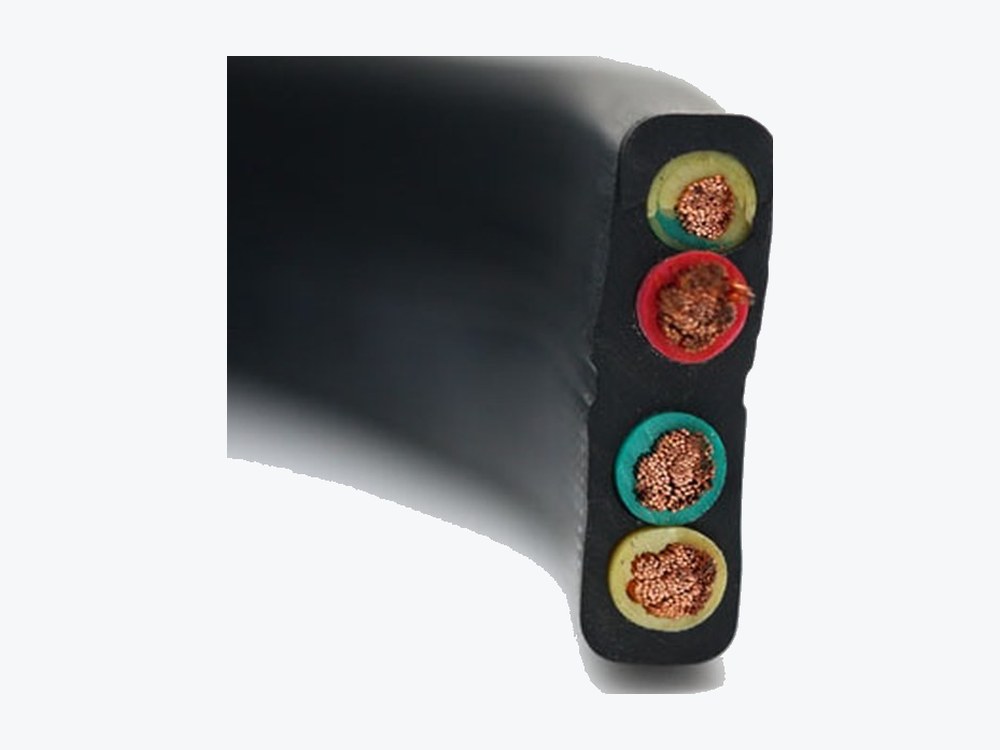
The model names are construction codes: T = drag chain (towline) service, R = flexible, V = PVC insulation, V = PVC jacket. Two optional letters follow: P = overall braided shield, S = cores twisted in pairs. All three types share the same flexible platform: fine-stranded copper conductors (Class 6 stranding practice), short lay lengths so the cores slide instead of crushing each other in the bend, and an abrasion-resistant flexible PVC jacket. In our range all three sit in the medium-speed drag chain class — the volume class for machine tools, handling and packaging equipment.
The three constructions side by side
| Type | Construction difference | Carries | Choose it when |
|---|---|---|---|
| TRVV | Unshielded. Cores stranded together, PVC jacket. | Power and simple control circuits | The run is electrically quiet: no drive nearby, no sensitive signals in the same chain. The economical default. |
| TRVVP | Adds an overall tinned-copper braid shield around the core bundle. | Power and control near variable-frequency drives; servo power | The cable itself must not radiate (drive-fed motor) or must not pick up noise. The braid is a Faraday cage against capacitive coupling. |
| TRVVSP | Cores twisted in pairs, plus the overall braid shield. | Encoder feedback, data and bus signals, measuring circuits | Signals travel as pairs. Twisting cancels magnetic (inductive) interference; the braid blocks electrostatic interference. The pair structure is what protects the signal — a plain shielded cable is not a substitute. |
A three-question decision
- Is it a signal or data circuit? → TRVVSP. Encoders, resolvers, bus lines and measuring circuits are pair signals; they need twisted pairs with an overall shield.
- Is it power or control, anywhere near a drive, servo amplifier or welding equipment? → TRVVP. The shield keeps drive harmonics in (and the neighbours’ noise out).
- Power or control in a quiet environment? → TRVV. Shielding adds cost, diameter and stiffness; where there is nothing to shield against, it buys nothing.
Scale check: our standard construction table lists 1,220 TRVV, 1,483 TRVVP and 300 TRVVSP constructions — core counts, sizes and pair layouts are standard items, not specials. You can browse and filter them in the cable selector.
What the grade does not change
Shielding grade is not flex grade. All three types share the same bending behaviour, and all three fail the same way when the installation is wrong — twisted laying, tight radius, tension. If you are replacing a failed cable, fix the installation first; then re-check the grade. And where the duty itself is harsher — high speed, long travel, oil, outdoor — the step up is not more shielding but a different platform: high-speed EKM7 types or PUR jackets.
Frequently asked questions
- Can TRVV carry encoder signals if the run is short?
- It is the classic false economy. Encoder feedback is a pair signal in the noisiest part of the machine; interference shows up as intermittent position faults that are hard to trace. Use TRVVSP — the price difference on a few metres is small against one afternoon of downtime.
- Is TRVVP always the safer choice?
- Not automatically. An unterminated or pigtailed shield can perform worse than no shield, and the braid adds diameter that may not fit a full chain. Choose the grade the circuit needs, and terminate the shield over 360° at the cabinet.
- Can I mix TRVV power and TRVVSP signal in one chain?
- Yes — that is the standard arrangement. Keep them in separate compartments with the chain’s separators, shielded types on the drive side, and the signal pairs away from the power run.
- What about servo motor cables — are they TRVVP?
- Servo power runs are usually shielded (TRVVP-type duty), but a purpose-built servo cable goes further: power cores plus an integrated, separately shielded brake pair in one jacket. See our servo motor cable range if the brake pair matters.
Not sure which grade your machine needs?
Tell us what the cable feeds — motor, drive model, encoder or control — and the chain size. We will pick the construction and quote from the standard table, usually within one working day.
TRVV high-flex power cables Request a quoteOutside the chain, the same constructions also serve robot dress packs — see our robot cables. And when a standard TRVV-family construction does not fit your machine, we build custom cable assemblies to your specification.