

EKM6 Series Drag Chain Cables: The Complete Model Guide
The EKM6 series is our medium-speed drag chain range — the volume range for machine tools, handling equipment and production lines. It holds 10,674 standard constructions in our cable selector: 3,558 in PVC and 7,116 in PUR. This guide explains the whole family: how to read a model number, what each of the twenty constructions is, and which one fits your chain.
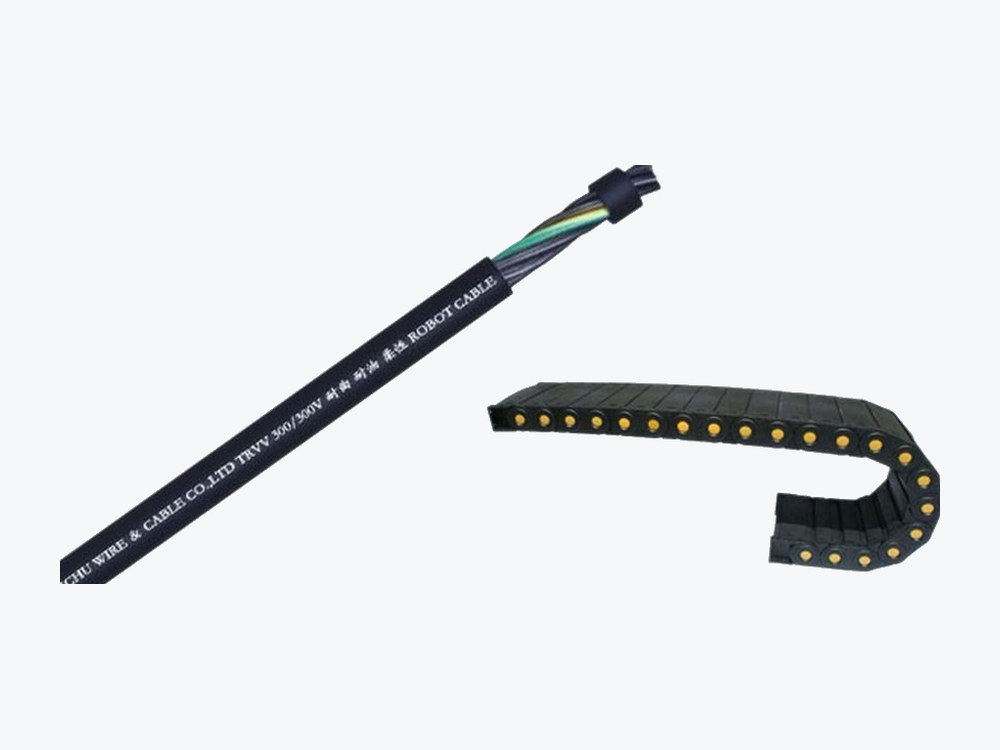
1. What the EKM6 series is
The series sits between the low-speed EKM51 range and the high-speed EKM71 range — special polymer, over 10 million bending cycles — and it is the range most machines actually run. The base model is the EKM61100: a high-flex PVC drag chain cable for medium-speed energy chains, rated up to 7 million bending cycles under factory test conditions. It uses fine-stranded oxygen-free copper (0.08/0.1 mm strands), tinned or bare, with a flexible PVC compound for insulation and jacket, cores identified by colour, dot or number marking, and jacket colours black, grey, orange and green. Rated voltage is 300/500 V, 450/750 V or 600/1000 V by construction, and the standard grid runs 2–36 cores × 0.14–6.0 mm², with up to 100 cores producible.
Everything else in the family is a variation on that base: add a shield, add a second sheath, twist the cores into pairs, or change the jacket to PUR. The model number tells you which — once you can read it, you can read the whole range.
10,674 standard constructions: 3,558 PVC + 7,116 PUR. Every one of them is listed in our cable selector with its stock code, construction, outer diameter and weight — the numbers in this guide are recomputed from that selector, not from a catalogue summary.
2. How to read an EKM6 model number
Every model is EKM6 + a sub-series (61 or 62) + a suffix that describes the construction. The suffix system is the factory’s drag-chain grading: the same grading is spelled out on our EKM71583 product page, where the EKM71583 is the top shielded-pair model of the high-speed grading (EKM71100, EKM71373, EKM71383, EKM71573, EKM71583) — the 71573 platform with an inner sheath added under the braid.
| Suffix | Construction | What it is for | Selector rows |
|---|---|---|---|
| 100 | Standard multi-core, unshielded | Control and power in the chain where no shield is needed | 463 per model |
| 373 | Shielded (copper braid) | Signals and control near drives — the shield keeps interference out | 463 per model |
| 383 | Shielded, double sheath | Shielded duty with an extra inner sheath for tougher chains | 463 per model |
| 573 | Twisted pairs | Signal circuits: pairs keep crosstalk down | 195 per model |
| 583 | Shielded twisted pairs + inner sheath | High-speed signal circuits — pairs plus braid plus inner sheath | 195 per model |
| 9xx | PUR version of the 1xx model | Same construction, PUR jacket instead of PVC | 926 per model (glossy + matte) |
| 97x / 98x | PUR version of the 57x / 58x model | Twisted pairs in PUR, glossy or matte finish | 390 per model (glossy + matte) |
Two sub-series share this system: EKM61xxx and EKM62xxx. Both are PVC, both use the same suffixes, and both cover the same spec grid (2–36 cores × 0.14–6.0 mm² for multi-core models). The 62 builds run slightly larger in outer diameter — EKM62100 spans 3.9–35.9 mm against EKM61100’s 3.7–32.8 mm — but we publish no other distinction between the two, so if your drawing names one, send it and we confirm the grade on enquiry.
The PUR models come in two surface finishes, glossy and matte, with identical grids: 463 rows each per multi-core model, 195 each per pair model. Pick the finish your chain or your customer asks for; the construction underneath is the same.
3. The ten PVC constructions
All ten PVC models, with selector counts and outer-diameter ranges recomputed from our data. Multi-core models cover 2–36 cores × 0.14–6.0 mm²; pair models cover 2–16 pairs × 0.14–2.5 mm².
| Model | Construction | Selector rows | Spec range | Outer diameter |
|---|---|---|---|---|
| EKM61100 | Standard multi-core, PVC | 463 | 2–36 cores × 0.14–6.0 mm² | 3.7–32.8 mm |
| EKM61373 | Shielded multi-core, PVC | 463 | 2–36 cores × 0.14–6.0 mm² | 4.1–33.7 mm |
| EKM61383 | Shielded, double sheath, PVC | 463 | 2–36 cores × 0.14–6.0 mm² | 5.4–37.7 mm |
| EKM61573 | Twisted pairs, PVC | 195 | 2–16 pairs × 0.14–2.5 mm² | 5.6–29.0 mm |
| EKM61583 | Shielded pairs + inner sheath, PVC | 195 | 2–16 pairs × 0.14–2.5 mm² | 6.9–32.8 mm |
| EKM62100 | Standard multi-core, PVC | 463 | 2–36 cores × 0.14–6.0 mm² | 3.9–35.9 mm |
| EKM62373 | Shielded multi-core, PVC | 463 | 2–36 cores × 0.14–6.0 mm² | 4.3–36.8 mm |
| EKM62383 | Shielded, double sheath, PVC | 463 | 2–36 cores × 0.14–6.0 mm² | 5.6–41.0 mm |
| EKM62573 | Twisted pairs, PVC | 195 | 2–16 pairs × 0.14–2.5 mm² | 6.0–31.6 mm |
| EKM62583 | Shielded pairs + inner sheath, PVC | 195 | 2–16 pairs × 0.14–2.5 mm² | 7.4–35.6 mm |
The shield adds diameter — compare EKM61100 at 3.7–32.8 mm with its shielded sister EKM61373 at 4.1–33.7 mm — and the double sheath adds more again. That is why the gland and the chain bend radius must be sized from the exact row, never from the base model.
4. The ten PUR constructions
The same ten constructions in PUR. Each model is listed twice in the selector — glossy and matte finish, identical grids — so the counts below are the two finishes combined. Multi-core models cover 2–36 cores × 0.14–6.0 mm²; pair models cover 2–16 pairs × 0.14–2.5 mm².
| Model | Construction | Selector rows | Spec range | Outer diameter |
|---|---|---|---|---|
| EKM61900 | Standard multi-core, PUR | 926 | 2–36 cores × 0.14–6.0 mm² | 3.6–32.4 mm |
| EKM61973 | Shielded multi-core, PUR | 926 | 2–36 cores × 0.14–6.0 mm² | 4.2–33.5 mm |
| EKM61983 | Shielded, double sheath, PUR | 926 | 2–36 cores × 0.14–6.0 mm² | 5.3–37.5 mm |
| EKM615973 | Twisted pairs, PUR | 390 | 2–16 pairs × 0.14–2.5 mm² | 5.6–28.8 mm |
| EKM615983 | Shielded pairs + inner sheath, PUR | 390 | 2–16 pairs × 0.14–2.5 mm² | 6.8–32.6 mm |
| EKM62900 | Standard multi-core, PUR | 926 | 2–36 cores × 0.14–6.0 mm² | 3.8–35.5 mm |
| EKM62973 | Shielded multi-core, PUR | 926 | 2–36 cores × 0.14–6.0 mm² | 4.4–36.6 mm |
| EKM62983 | Shielded, double sheath, PUR | 926 | 2–36 cores × 0.14–6.0 mm² | 5.5–40.8 mm |
| EKM625973 | Twisted pairs, PUR | 390 | 2–16 pairs × 0.14–2.5 mm² | 5.9–31.5 mm |
| EKM625983 | Shielded pairs + inner sheath, PUR | 390 | 2–16 pairs × 0.14–2.5 mm² | 7.2–35.4 mm |
PUR is the jacket to pick when the chain runs in oil, coolant or UV, or where abrasion is the failure you have seen — the PVC-versus-PUR trade-off is covered in our guide to PVC vs PUR drag chain cables. No bending-life figure is published for the EKM61900/62900 PUR models: send the chain speed and the expected cycle count and we confirm the grade on enquiry.
5. Worked example: bend radius and six real rows
The minimum bend radius is a multiple of the cable’s outer diameter: 7.5× for a moving (dynamic) installation and 4× for a fixed one. Leave about 10% slack in the chain so the cable is never pulled tight at full travel. Worked example: EKM61100 4 × 2.5 mm² (H101550025004) has an outer diameter of 9.8 mm, so the chain’s bend radius must be at least 73.5 mm while moving and 39.2 mm fixed. The full method is in our guide to minimum bend radius for drag chain cables.
Six real stock sizes from our cable selector — stock code, model, construction, outer diameter and weight:
| Stock code | Model | Construction | Outer dia. | Weight |
|---|---|---|---|---|
| H101550001410 | EKM61100 | 0.14×10C | 6.1 mm | 63 kg/km |
| H101560001410 | EKM61373 | 0.14×10C | 6.5 mm | 76 kg/km |
| H101580001410 | EKM61573 | 0.14×2×10P | 9.5 mm | 151 kg/km |
| H101600001410 | EKM62100 | 0.14×10C | 6.5 mm | 66 kg/km |
| J101570001410 | EKM61900 (glossy) | 0.14×10C | 5.7 mm | 52 kg/km |
| J101600001410 | EKM615973 (glossy) | 0.14×2×10P | 9.5 mm | 140 kg/km |
Find your exact size in the cable selector, or browse the drag chain cable range.
6. Which model for which job
| Your job | Pick | Why |
|---|---|---|
| Control and power in a standard chain, no shield needed | EKM61100 / EKM62100 | The base model: PVC, up to 7 million cycles published, the widest stock grid |
| Signals or control running past drives | EKM61373 / EKM62373 | The braid keeps interference out; terminate it 360° at both ends |
| Shielded duty in a hard-working chain | EKM61383 / EKM62383 | Shield plus inner sheath — the toughest PVC build in the family |
| Encoder, sensor or signal pairs | EKM61573 / EKM62573 | Twisted pairs keep crosstalk down between circuits |
| Signal pairs past drives, at speed | EKM61583 / EKM62583 | Pairs plus braid plus inner sheath — the top PVC build |
| Oil, coolant, UV or abrasion in the chain | EKM61900 / EKM62900 family | PUR jacket; glossy or matte finish, same construction underneath |
How many cycles you actually need — and how to count them from your chain speed — is worked out in our guide to how many bending cycles you actually need. Shield termination itself — the 360° gland or clamp at both ends, never a pigtail — is in our guide to cable glands and shield termination, and chain installation practice in our drag chain cable installation guide.
Frequently asked questions
- What is the difference between EKM61100 and EKM62100?
- Both are PVC medium-speed models using the same suffix system and the same spec grid (2–36 cores × 0.14–6.0 mm²). The 62 builds run slightly larger in outer diameter. We publish no other distinction between the two — send the model your drawing names and we confirm the grade on enquiry.
- What does the 373 in EKM61373 mean?
- It is the shielded build: a copper braid over the cores, under a single sheath. The 383 adds a second (inner) sheath under the braid, the 573 is twisted pairs, and the 583 is shielded twisted pairs with an inner sheath. The 9xx models are the same constructions in PUR.
- Which EKM6 model is right for encoder or sensor signals?
- A pair model: EKM61573 / EKM62573 in PVC, or EKM615973 / EKM625973 in PUR. Twisted pairs keep crosstalk down, and the 583 / 5983 pair adds a braid and an inner sheath where the pairs run past drives.
- What bending life can I expect?
- Only the EKM61100 has a published figure: up to 7 million bending cycles under factory test conditions. For every other EKM6 model, send the chain speed and the expected cycle count and we confirm the grade on enquiry.
- What if my construction is not in the selector?
- Send the cores, the shielding, the jacket and the length. Custom builds start at 300 m, and we usually quote within one working day.
Send the model number, the size and the chain
Send the EKM6 model, the cores and the outer diameter — plus the chain speed and the expected cycles if you want the grade confirmed. We will confirm the construction and quote usually within one working day.
Cable Selector WhatsApp Request a Quote