

KVV Control Cables: The Complete Model Guide
KVV is the workhorse control cable: copper cores, PVC insulation and a PVC sheath, built for the control, monitoring and protection circuits inside panels, machines and plants. It is not a drag-chain cable and not a power cable — it is the cable that carries signals and switching commands where the run is fixed or only moves occasionally. Our cable selector lists 21,986 standard control-cable constructions in this family — KVV and its nine siblings. This guide explains the whole family: how to read a model code, what each member is, and which one fits your panel.
1. What KVV is
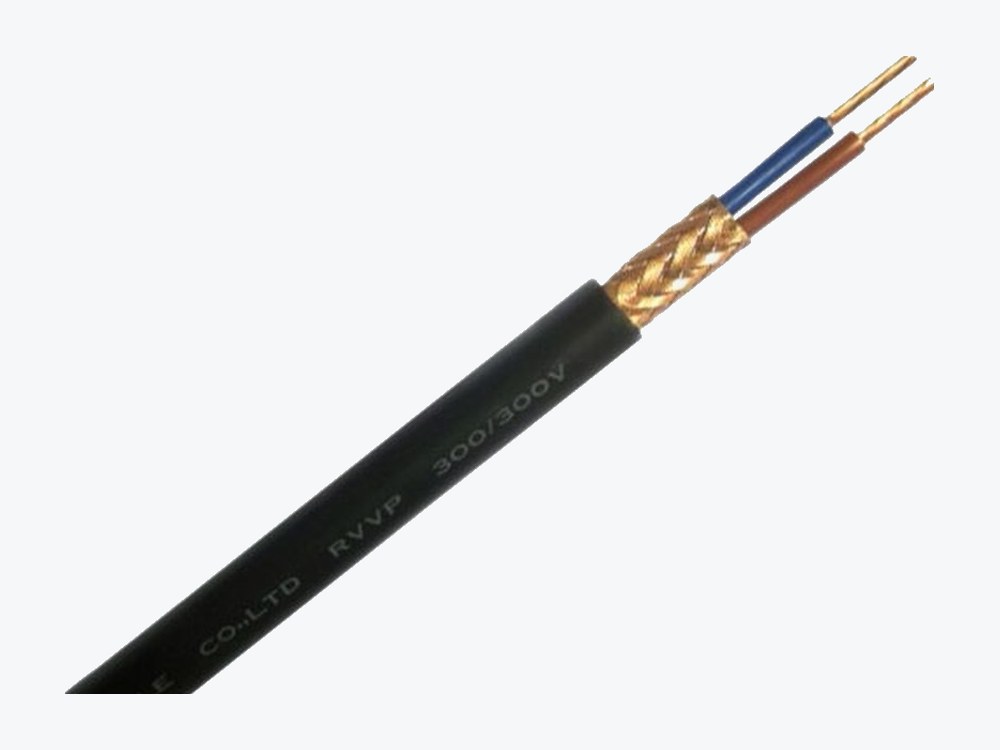
The build is a fixed control cable to the factory’s published data: bare oxygen-free copper conductors, PVC insulation, black cores numbered in white (three cores and up with an optional yellow-green earth core), a non-woven inner wrap and a black or grey PVC sheath. Rated voltage is 450/750 V, test voltage 3,000 V, and the conductor’s long-term working temperature is 70 °C. It is made for control, monitoring and protection circuits — the wiring between a panel, its contactors, relays, sensors and actuators — laid fixed indoors, in cable trenches or in conduit. The shielded sister of the family is our Shielded Control Cable RVVP, and the selector below it lists the full control-cable grid — 21,986 standard constructions across ten sub-groups, 2–38 cores × 0.5–25 mm².
KVV is the fixed-installation member. If the run has to move, the family has a flexible member for that (KVVR); if the signal needs screening, there is a shielded member (KVVP); if the run needs mechanical protection, there is an armoured member (KVV22). Picking the wrong member is the most common mistake in control cabling: a stiff KVV forced to flex will crack at the gland, and an unshielded KVV run beside a drive will pick up the noise you then spend days chasing. The rest of this guide is about telling the members apart before you order.
21,986 standard constructions: KVV 1,617 + KVVR 4,347 + KVVP 3,638 + KVVRP 7,581 + KVV22 1,288 + KVVR22 3,115 + fire-resistant 400. Every one of them is listed in our cable selector with its stock code, construction, outer diameter and weight — the numbers in this guide are recomputed from that selector, not from a catalogue summary.
2. How to read a KVV model code
The model names are construction codes. Each letter adds one fact about the build:
| Code part | Meaning | What it tells you |
|---|---|---|
| K | Control cable | Built for control, monitoring and protection circuits |
| V | PVC insulation | PVC insulation on each copper core |
| V | PVC sheath | Black or grey PVC outer sheath |
| R | Flexible build | Softer construction for moving or frequently handled runs (KVVR, KVVRP) |
| P | Braided shield | Copper braid screen around the cores (KVVP, KVVRP) |
| 22 | Steel-tape armour | Armoured build for mechanical protection (KVV22, KVVR22) |
| ZR- / ZC- | Flame-retardant prefix | Same size grid as the base model, flame-retardant sheath |
| NH- | Fire-resistant prefix | Fire-resistant build, same size grid (NH-KVV, ZCN-KVV) |
So KVV is the fixed base, KVVR is the flexible version, KVVP adds a braided shield, and KVVRP is flexible and shielded. The 22 suffix is the armoured version, ZR- or ZC- in front means flame-retardant, and NH- means fire-resistant. Once you can read it, you can read the whole range.
| Type | Construction difference | Carries | Choose it when |
|---|---|---|---|
| KVV | Fixed, unshielded, PVC/PVC. | Control and switching signals in fixed runs | The run is fixed — panel wiring, trunking, conduit, cable trench. The economical default. |
| KVVR | Flexible version of KVV. | Control signals on runs that move or are re-terminated | The cable is handled, re-routed or flexed occasionally; a stiff cable would fatigue at the gland. |
| KVVP | Adds a braided shield to KVV. | Control signals beside drives, contactors and mains runs | Noise is the risk — the braid keeps interference out of the control circuit. |
| KVVRP | Flexible and shielded. | Control signals that move and need screening | You need both the flexibility of KVVR and the shielding of KVVP. |
| KVV22 / KVVR22 | Steel-tape armour over the fixed / flexible build. | Control circuits in trenches, ducts and exposed runs | The cable can be crushed or struck — the armour, not the sheath, takes the blow. |
| NH-KVV / ZCN-KVV | Fire-resistant build. | Control circuits that must keep working in a fire | The circuit is safety-critical; ask us to confirm the fire rating for your project. |
3. The family in numbers
All ten sub-groups, with selector counts and outer-diameter ranges recomputed from our data. Each sub-group is listed under several build variants — standard, cold-resistant to −30 °C or −40 °C, flame-retardant ZR- at 70/80/105 °C and ZC- — all sharing the same size grid, so the counts below count selector rows and the spec ranges show the distinct size grid.
| Sub-group | Construction | Selector rows | Spec range | Outer diameter |
|---|---|---|---|---|
| KVV | Fixed, unshielded | 1,617 | 2–38 cores × 0.5–16 mm² | 6.6–31.1 mm |
| KVVR (national standard) | Flexible, unshielded | 2,135 | 2–37 cores × 0.5–16 mm² | 6.7–31.0 mm |
| KVVR (full-section) | Flexible, unshielded | 2,212 | 2–38 cores × 0.5–25 mm² | 6.7–31.0 mm |
| KVVP | Fixed, braided shield | 3,638 | 2–38 cores × 0.5–25 mm² | 7.0–37.0 mm |
| KVVRP (national standard) | Flexible, braided shield | 3,745 | 2–38 cores × 0.5–16 mm² | 7.1–39.2 mm |
| KVVRP (full-section) | Flexible, braided shield | 3,836 | 2–38 cores × 0.5–16 mm² | 7.1–40.2 mm |
| KVV22 | Fixed, steel-tape armoured | 1,288 | 2–38 cores × 1.0–16 mm² | 10.0–36.1 mm |
| KVVR22 (national standard) | Flexible, steel-tape armoured | 1,561 | 2–38 cores × 0.5–16 mm² | 10.0–33.0 mm |
| KVVR22 (full-section) | Flexible, steel-tape armoured | 1,554 | 2–38 cores × 0.5–16 mm² | 10.0–33.0 mm |
| Fire-resistant (NH-KVV / ZCN-KVV) | Fire-resistant | 400 | 2–38 cores × 0.75–10 mm² | 9.0–37.0 mm |
Two things stand out. First, the shielded and armoured members run larger at the same core count — compare KVV 4 cores × 1.5 mm² with KVV22 4 cores × 1.5 mm² in the worked rows below: the armour adds millimetres, and the gland and conduit must be sized from the exact row, never from the base model. Second, KVV22 starts at 1.0 mm², not 0.5 mm²: the smallest armoured builds are not listed, so a 0.5 or 0.75 mm² armoured KVV22 is an enquiry, not a stock size.
4. National-standard vs full-section, and braid density
KVVR, KVVRP and KVVR22 each come in two conductor series: a national-standard series and a full-section series. At the same size the two have the same outer diameter — the full-section build simply carries more copper, so it weighs more: KVVR 1.5 mm² × 4 cores is 142 kg/km in the national-standard series and 149 kg/km full-section; KVVRP 1.5 mm² × 4 cores is 181 kg/km against 184 kg/km. The full-section grid also runs further: KVVR full-section reaches 25 mm² and 38 cores, while the national-standard grid stops at 16 mm² and 37 cores. If your specification calls for full-section conductors, say so in the enquiry — the model code alone does not tell us which series you want.
The shielded members come in two braid-density series as well: an 80% braid series and an enterprise-standard-density series. The two grids differ slightly — KVVP lists 265 sizes in the enterprise-standard series and 253 in the 80% series’ cold-resistant and flame-retardant variants (the base 80% model lists the same 265-size grid); KVVRP national-standard lists 286 against 249, and KVVRP full-section 292 against 256. If your project specifies a braid density, name it with the model; otherwise we quote the standard build. The factory catalogue also lists a KVVP2 — a copper-tape-shielded variant — but it has no rows in our selector, so treat it as confirm on enquiry.
5. Worked example: bend radius and six real rows
The minimum bend radius is a multiple of the cable’s outer diameter, and the multiple depends on the build. The factory’s published rule: armoured cable, not less than 6× the outer diameter; unarmoured cable, not less than 12×; shielded flexible cable, not less than 6×. Worked examples: KVV 1.5 mm² × 4 cores (D101010015004) has an outer diameter of 9.4 mm, so as an unarmoured cable it must not be bent tighter than a 112.8 mm radius. KVV22 1.5 mm² × 4 cores (D101050015004) has an outer diameter of 12.0 mm, so as an armoured cable its minimum radius is 72 mm. KVVRP full-section 1.5 mm² × 4 cores (D116040015004) has an outer diameter of 10.0 mm, so as a shielded flexible cable its minimum radius is 60 mm. The full method is in our guide to minimum bend radius for drag chain cables.
Six real stock sizes from our cable selector — stock code, model, construction, outer diameter and weight:
| Stock code | Model | Construction | Outer dia. | Weight |
|---|---|---|---|---|
| D101010015002 | KVV | 1.5×2C | 8.2 mm | 95 kg/km |
| D101010015004 | KVV | 1.5×4C | 9.4 mm | 146 kg/km |
| D101010010007 | KVV | 1.0×7C | 9.7 mm | 158 kg/km |
| D116030015004 | KVVP | 1.5×4C | 9.8 mm | 162 kg/km |
| D101050015004 | KVV22 | 1.5×4C | 12.0 mm | 276 kg/km |
| D116040015004 | KVVRP (full-section) | 1.5×4C | 10.0 mm | 184 kg/km |
Weight is worth checking before you order a drum: KVV 1.5 mm² × 4 cores at 146 kg/km means 100 m weighs 14.6 kg. And one honest gap in the data: the fire-resistant NH-KVV (full-section) weights are not listed in our selector — the source table carries a spreadsheet error there — so for NH-KVV weights, ask us to confirm. Its sister ZCN-KVV is listed: 1.5 mm² × 4 cores (D1015P0015004) is 11.7 mm outer diameter and 198 kg/km.
6. Ratings, temperature and installation
The factory’s published ratings for the whole KVV family are the same across the members, so one table covers them all:
| Rating | Published value |
|---|---|
| Rated voltage U0/U | 450/750 V |
| Test voltage | 3,000 V |
| Conductor long-term working temperature | 70 °C |
| Use temperature, moving installation | −5 °C to +70 °C |
| Use temperature, fixed installation | −15 °C to +70 °C |
| Laying temperature | Not below 0 °C |
| Minimum bend radius, armoured | 6× outer diameter |
| Minimum bend radius, unarmoured | 12× outer diameter |
| Minimum bend radius, shielded flexible | 6× outer diameter |
Two practical notes. First, the 12× rule for unarmoured KVV is much gentler than a drag-chain cable’s bend radius — KVV is a fixed cable, and a tight bend at a panel entry is the usual way it gets damaged. Second, the shield only works if it is terminated properly: a pigtail tail at the gland throws away the screening you paid for, so terminate the braid 360° at the gland. Our guide to cable glands and shield termination shows the 360° method and why the pigtail defeats it. And one honest difference between the factory catalogue and our selector: the catalogue’s printed KVV table lists only a short selection (3, 4 and 5 cores × 0.5–16.0 mm², plus one 0.5 mm² × 7-core size), while our selector lists the full grid to 2–38 cores shown above. Sizes outside the selector grid are made to order — send the specification and we will confirm availability.
7. How to choose
| Your job | Choose | Why |
|---|---|---|
| Fixed panel wiring, trunking, conduit | KVV | The fixed base does the job at the lowest cost; nothing in the run moves or needs screening. |
| Control cable to a moving machine part or a cabinet that is re-wired often | KVVR | The flexible build survives handling; a stiff KVV would fatigue at the gland. |
| Control runs beside drives, contactors or long parallel mains runs | KVVP | The braided shield keeps interference out of the control circuit — the usual fix for phantom switching. |
| Moving run that also needs screening | KVVRP | Flexibility and shielding in one build; size the gland from the exact row, it runs larger than KVV. |
| Trench, duct or exposed run where the cable can be struck or crushed | KVV22 / KVVR22 | Steel-tape armour takes the mechanical load; the shield still does the electrical work on KVVR22. |
| Safety-critical circuit that must keep working in a fire | NH-KVV / ZCN-KVV | Fire-resistant build on the same size grid — ask us to confirm the fire rating for your project. |
Frequently asked questions
- What is the difference between KVV and KVVR?
- KVV is the fixed control cable and KVVR is its flexible version — same PVC insulation and sheath, same 450/750 V rating, but softer conductors and construction for runs that move or are handled often. Use KVV for fixed panel and trunking work, KVVR where the cable is re-routed or flexed.
- When do I need the shielded KVVP instead of plain KVV?
- When the control run passes drives, contactors, or long parallel mains cables. The copper braid screen keeps interference out of the control circuit — the usual cause of phantom switching and false signals. Terminate the braid 360° at the gland; a pigtail tail throws the screening away.
- What sizes are actually in stock?
- Our selector lists KVV in 2–38 cores × 0.5–16 mm² — 1,617 standard rows, plus the KVVR, KVVP, KVVRP and armoured 22 members to 21,986 rows in total. The factory catalogue prints a shorter partial list (3, 4 and 5 cores × 0.5–16.0 mm²); sizes outside the selector grid are made to order.
- Can I use KVV outdoors or buried?
- Only the armoured members: KVV22 and KVVR22 are built for trenches, ducts and runs that can take a mechanical blow, with a 6× bend radius. Unarmoured KVV is a fixed indoor cable — for a buried or exposed run, pick the 22 build or ask us to confirm.
- What if my size is not in the selector?
- Send us the model, core count, conductor size and outer diameter you need — plus what the cable connects to, so we can confirm the construction. Custom builds start from 300 m, and we usually give a formal quote within one working day. See also our guide to custom cable assemblies made to drawing.
Send the model, core count and diameter
Send the KVV model, core count and outer diameter — plus what the cable connects to, if you want us to confirm the shielding level. We confirm the construction and usually quote within one working day.
Cable Selector WhatsApp Request a Quote