

High-Flex Power Cables: How to Choose (Bend Radius, Duty, Jacket)
A high-flex power cable fails in the chain, not on the test bench. The three choices that decide its life are the duty class, the bend radius and the jacket — and all three can be read off the construction before you order. This guide works through them with real sizes from our EKM61100 range.
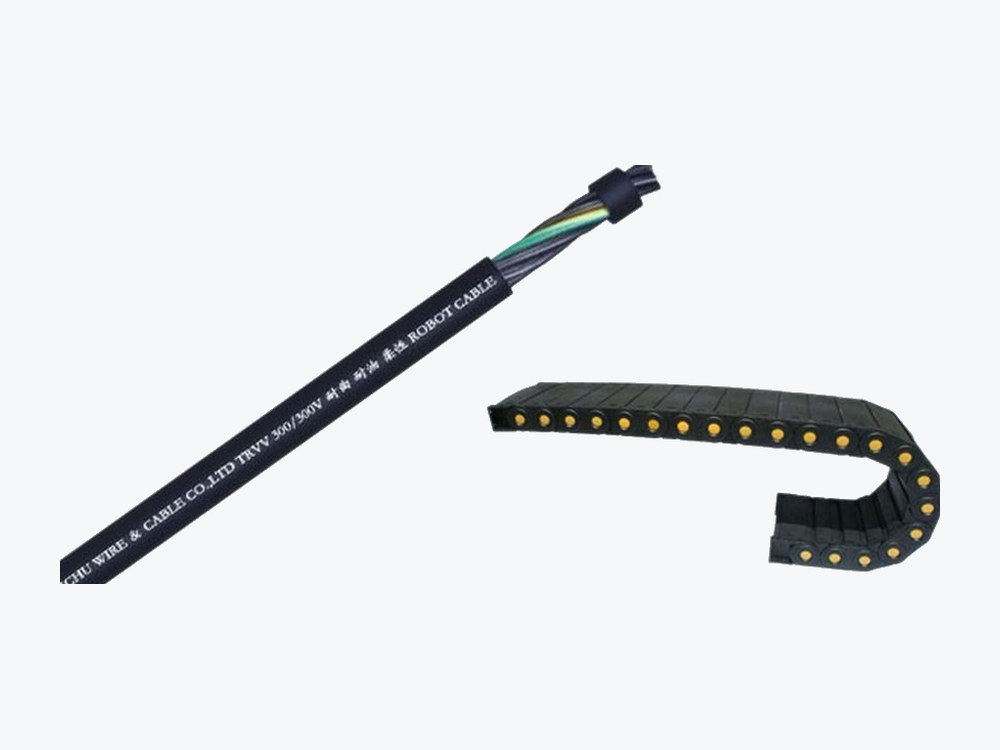
1. Start with the duty: low, medium or high speed
Our drag chain range is graded by speed. The medium-speed range is the one that sells the most: the EKM6 series and the TRVV family for machine tools, handling equipment and production lines. High-flex power cables are built on the same idea — fine-stranded conductors and a flexible special-polymer insulation and jacket, made for drag chain systems and frequently moving machine parts.
| Duty | Family | Jacket | Bending life* | Where it fits |
|---|---|---|---|---|
| Low speed | EKM51 series (EKM51100 / 51373 / 51573) | PVC | See product page | Slower chains |
| Medium speed | EKM6 series, TRVV / TRVVP / TRVVSP | PVC (EKM61100) | Up to 7 million cycles | Machine tools, handling equipment, production lines — the volume range |
| High speed | EKM71 series (EKM71100 / 71900) | Special polymer (EKM71100), PUR (EKM71900) | Over 10 million cycles (EKM71100); over 20 million cycles (EKM71900) | Fast, long-travel energy chains |
* Bending life is stated under factory test conditions. Compare constructions on their own stated figure, not on a catalogue headline.
2. Then the bend radius: 7.5× moving, 4× fixed
The minimum bend radius is a multiple of the cable’s outer diameter: 7.5× for a moving (dynamic) installation and 4× for a fixed one. Leave about 10% slack in the chain so the cable is never pulled tight at full travel. The table below works it out for real EKM61100 stock sizes, taken from our cable selector.
| Stock code | Construction | Outer diameter | Min. radius, moving (7.5×) | Min. radius, fixed (4×) |
|---|---|---|---|---|
| H101550005004 | 4 × 0.5 mm² | 5.6 mm | 42.0 mm | 22.4 mm |
| H101550007504 | 4 × 0.75 mm² | 6.2 mm | 46.5 mm | 24.8 mm |
| H101550015003 | 3 × 1.5 mm² | 7.4 mm | 55.5 mm | 29.6 mm |
| H101550015004 | 4 × 1.5 mm² | 8.2 mm | 61.5 mm | 32.8 mm |
| H101550015005 | 5 × 1.5 mm² | 8.9 mm | 66.8 mm | 35.6 mm |
| H101550025003 | 3 × 2.5 mm² | 8.9 mm | 66.8 mm | 35.6 mm |
| H101550025004 | 4 × 2.5 mm² | 9.8 mm | 73.5 mm | 39.2 mm |
| H101550025005 | 5 × 2.5 mm² | 10.8 mm | 81.0 mm | 43.2 mm |
Worked example: EKM61100 4 × 2.5 mm² (H101550025004) has an outer diameter of 9.8 mm, so the chain’s bend radius must be at least 73.5 mm while moving and 39.2 mm fixed. If your chain bends tighter than that, step up a size or a higher duty class — do not force the cable. The full method is in our guide to minimum bend radius for drag chain cables.
3. Then the jacket: PVC, special polymer or PUR
| Jacket | Model | Bending life* | Pick it when |
|---|---|---|---|
| PVC | EKM61100 | Up to 7 million cycles | Standard medium-speed chains — the default choice |
| Special polymer | EKM71100 | Over 10 million cycles | High-speed chains where PVC reaches its limit |
| PUR (glossy or matt) | EKM71900 | Over 20 million cycles | Abrasion, oils and very long service life |
All three use fine-stranded, high-purity oxygen-free copper conductors (0.08/0.1 mm strands, tinned or bare) and come in black, grey, orange or green jackets.
4. Check the electrical side before you order
- Rated voltage: 300/500 V, 450/750 V or 600/1000 V, by construction.
- Cores and cross-sections: 2–8+ cores × 1.5–50 mm² from the standard grid; conductor sizes up to 300 mm² producible.
- EKM61100 range: 2–36 cores × 0.14–6.0 mm² from the standard grid, up to 100 cores producible.
- Need something outside the grid? Custom builds start at 300 m — send the specification for a formal quote, usually within one working day.
Find your exact size in the cable selector, or browse the full drag chain cable range.
5. The mistakes that cost the most
| Mistake | What it causes | Fix |
|---|---|---|
| Sizing by price, not by duty | A cable that passes the bench test and fails in the chain | Match the duty class to the chain speed first |
| Bending tighter than 7.5× outer diameter | Broken cores and corkscrewing | Size the chain radius from the table, not from a catalogue photo |
| No slack in the chain | The cable pulled tight at full travel | Leave about 10% slack |
| PVC where oil and abrasion rule | Jacket wear long before the cores tire | Step up to PUR (EKM71900) |
| Ordering a catalogue size for a special machine | A construction that almost fits | Ask for a made-to-drawing quote — custom runs start at 300 m |
Frequently asked questions
- What bend radius does a high-flex power cable need?
- 7.5× the outer diameter while moving, 4× fixed, with about 10% slack in the chain. The table above works it out for real EKM61100 sizes — for example 4 × 2.5 mm² needs at least 73.5 mm moving.
- PVC or PUR jacket?
- PVC is the standard for medium-speed chains (EKM61100, up to 7 million cycles). PUR (EKM71900, over 20 million cycles) is for abrasion, oils and very long service life. Special polymer (EKM71100, over 10 million cycles) covers high-speed chains where PVC reaches its limit.
- What voltages are these cables rated for?
- 300/500 V, 450/750 V or 600/1000 V, depending on the construction.
- Can I get a size that is not in the table?
- The standard grid covers 2–8+ cores × 1.5–50 mm², with conductors up to 300 mm² producible. Custom builds start at 300 m — send the specification for a formal quote, usually within one working day.
Tell us the chain, the travel and the load
Send the chain type, the bend radius, the travel length and the cores you need. We will confirm the construction and quote usually within one working day.
High-Flex Power Cable Request a Quote