

Robot Cable Assemblies for Dress Packs and Moving Axes
A robot dress pack carries power, feedback and signal through the same bundle while the arm twists and the chain bends — and the cable that fails is usually the one sized for only one of those two movements. This guide works through both, with real sizes from our robot torsion range.
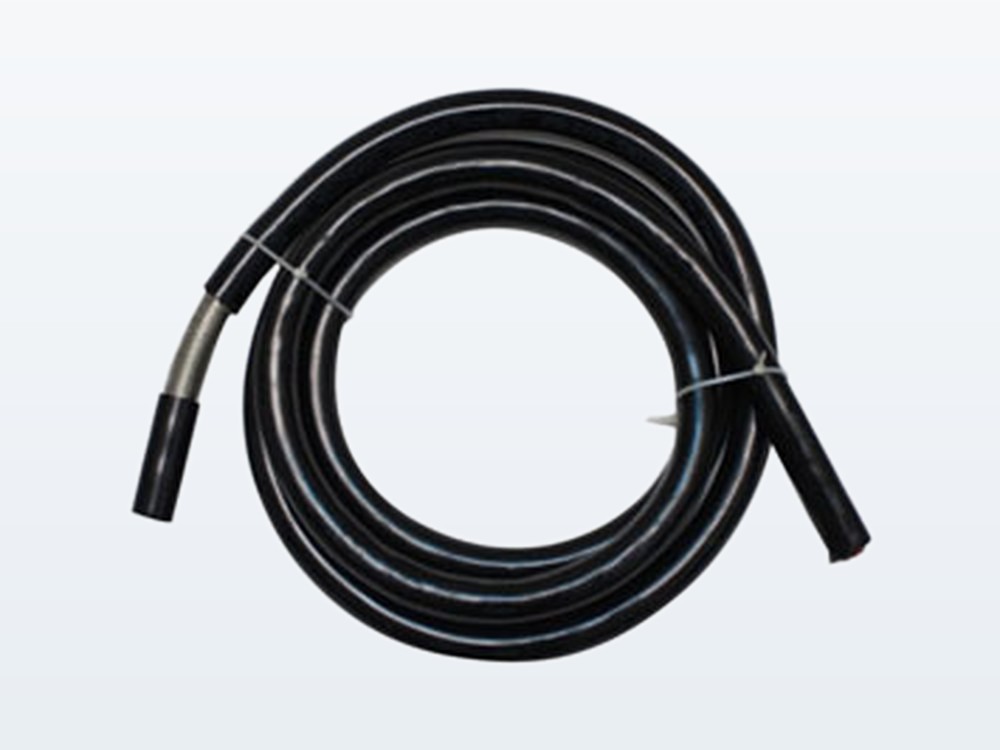
1. Two movements in one bundle
On a moving axis the cable sees two loads at once. At the wrist and the rotating joints it twists — our torsion cables are built for ±180° (360° of total travel) on the TPEE range and ±270° on the ETFE range. In the dress pack chain it bends, again and again: the drag chain cable for the same cell is graded at over 5, 10 or 20 million bending cycles. And the same bundle usually carries three jobs at once — servo power with its brake pair, encoder feedback, and the robot’s own power and signal cores — so the choice is a system choice, not a single cable.
2. The torsion family: six models, two insulations
Robot torsion cables are built for the twisting duty of multi-axis robot arms, and they also serve in high-speed drag chains and withstand heavy oil exposure, including oil immersion. The family comes in two insulations:
| Model | Insulation / jacket | Shielding | Torsion | Rated voltage |
|---|---|---|---|---|
| ROBOT 83900 | TPEE / matt PUR | Unshielded | ±180° | 300 V |
| ROBOT 83974 | TPEE / matt PUR | Shielded | ±180° | 300 V |
| ROBOT 835974 | TPEE / matt PUR | Shielded twisted pairs | ±180° | 300 V |
| ROBOT 81900 | ETFE / matt PUR | Unshielded | ±270° | 300 V |
| ROBOT 81974 | ETFE / matt PUR | Shielded | ±270° | 300 V |
| ROBOT 815974 | ETFE / matt PUR | Shielded twisted pairs | ±270° | 300 V |
All six share the same base: high-purity tinned oxygen-free copper conductors (0.08/0.1 mm strands), a matt PUR jacket in black, grey, orange or green, −40 °C to +90 °C, and 2–20 cores × 0.14–2.5 mm² from the standard grid, up to 100 cores producible. The TPEE range is listed in our cable selector — 684 standard rows across five sub-series (the selector also lists 83973 and 835973 variants alongside the manual models). The ETFE range is quoted on request rather than picked from the selector.
3. The dress-pack chain cable
Where the bundle runs in the chain rather than twisting at the joint, the construction changes. Robot drag chain cable is a PUR-jacketed drag chain cable (glossy or matt) for robot dress packs and frequently moving machine parts, in three bending-life grades — over 5, 10 or 20 million cycles (factory test conditions). Rated voltage is 300/500 V, 450/750 V or 600/1000 V by construction, and the selector lists 900P at 2–38 cores × 0.14–35 mm² and 900DP at 2–38 cores × 0.14–25 mm².
| Series | Jacket | Shielding | Bending life* | Selector rows |
|---|---|---|---|---|
| 900P (older generation) | PUR, glossy or matt | Unshielded | Over 5, 10 or 20 million cycles by grade | 539 |
| 900DP (older generation) | PUR, glossy or matt | Shielded | Over 5, 10 or 20 million cycles by grade | 481 |
* Bending life is stated under factory test conditions. The two series together cover 1,020 standard rows in the selector — the full drag-chain side of the robot group (1,704 rows in total).
4. Worked sizes: the 10× bend radius
Torsion cables state their bend radius as a multiple of the outer diameter: 10×D. The table works it out for real stock sizes from our cable selector:
| Stock code | Model | Construction | Outer diameter | Min. bend radius (10×) |
|---|---|---|---|---|
| V101110005002 | ROBOT 83974 | 0.5 × 2C | 6.1 mm | 61 mm |
| V101110005004 | ROBOT 83974 | 0.5 × 4C | 6.7 mm | 67 mm |
| V101110005010 | ROBOT 83974 | 0.5 × 10C | 9.9 mm | 99 mm |
| V101090001402 | ROBOT 83900 | 0.14 × 2C | 4.1 mm | 41 mm |
| V101090001410 | ROBOT 83900 | 0.14 × 10C | 6.3 mm | 63 mm |
| V101130001402 | ROBOT 835974 | 0.14 × 2C × 2 | 5.8 mm | 58 mm |
Worked example: ROBOT 83974 0.5 × 10C (V101110005010) has an outer diameter of 9.9 mm, so the dress pack must allow at least 99 mm of bend radius at the twist. Size the guide from the table — do not force the cable. The full range is in the robot cable range.
5. What to send for a quote
- Which movement: torsion at the joint, bending in the chain, or both — and the angle or travel.
- Cores and cross-section: robot power and signal, plus the servo power cores and brake pair and the encoder feedback line if they ride in the same bundle.
- Shielding: unshielded, shielded, or shielded twisted pairs.
- Jacket: matt PUR is standard — say if oil immersion or heavy abrasion applies.
- Length and quantity: custom builds start at 300 m.
- A drawing, datasheet or the part number of the cable you use today, if you have one.
Our guide to custom cable assemblies, made to drawing explains what to send and what the quote states. Servo and encoder lines that share the bundle are covered on the servo motor cable and encoder cable pages — the encoder line is made to drawing, with no standard selector rows. Formal quotes usually arrive within one working day.
6. The mistakes that cost the most
| Mistake | What it causes | Fix |
|---|---|---|
| Sizing a torsion cable by bend radius alone | A cable that survives the chain and fails at the wrist | Check the torsion angle first — ±180° TPEE or ±270° ETFE |
| Putting a fixed-installation cable in a dress pack | Broken cores within weeks | Use a drag chain or torsion construction, not a fixed cable |
| Forgetting the encoder line | Feedback faults that look like a drive problem | Shielded twisted pairs for the feedback cores |
| Ordering a catalogue size for a special cell | A construction that almost fits | Ask for a made-to-drawing quote — custom runs start at 300 m |
| No room at the twist | The cable pulled tight at full rotation | Leave room at the joint; size the guide from the 10× table |
Frequently asked questions
- Torsion cable or drag chain cable — which one does a robot need?
- Both, in different places: torsion cable at the twisting joints and axes, drag chain cable in the dress pack chain. The same cell often needs both.
- What does ±180° torsion mean?
- The cable twists 180° each way from centre — 360° of total travel. The ETFE range twists ±270°.
- What bend radius does a robot torsion cable need?
- 10× the outer diameter. The table above works it out for real sizes — for example ROBOT 83974 0.5 × 10C needs at least 99 mm.
- Can I get a size that is not in the table?
- The standard grid covers 2–20 cores × 0.14–2.5 mm², up to 100 cores producible, and custom builds start at 300 m — send the specification for a formal quote, usually within one working day. The ETFE range is quoted on request.
Tell us the axis, the travel and the bundle
Send the axis type, the torsion angle or travel length, and the cores you need — power, brake pair, encoder feedback. We will confirm the construction and quote usually within one working day.
Robot Cables Request a Quote