

Drag Chain Cable Installation: The Rules That Decide Flex Life
Most drag chain cables do not wear out — they are installed out. The cable itself is engineered for millions of bending cycles, but a twisted lay, a tight bend or a clamped-flat jacket can cut that life to a few months. These are the installation rules that decide which outcome you get.
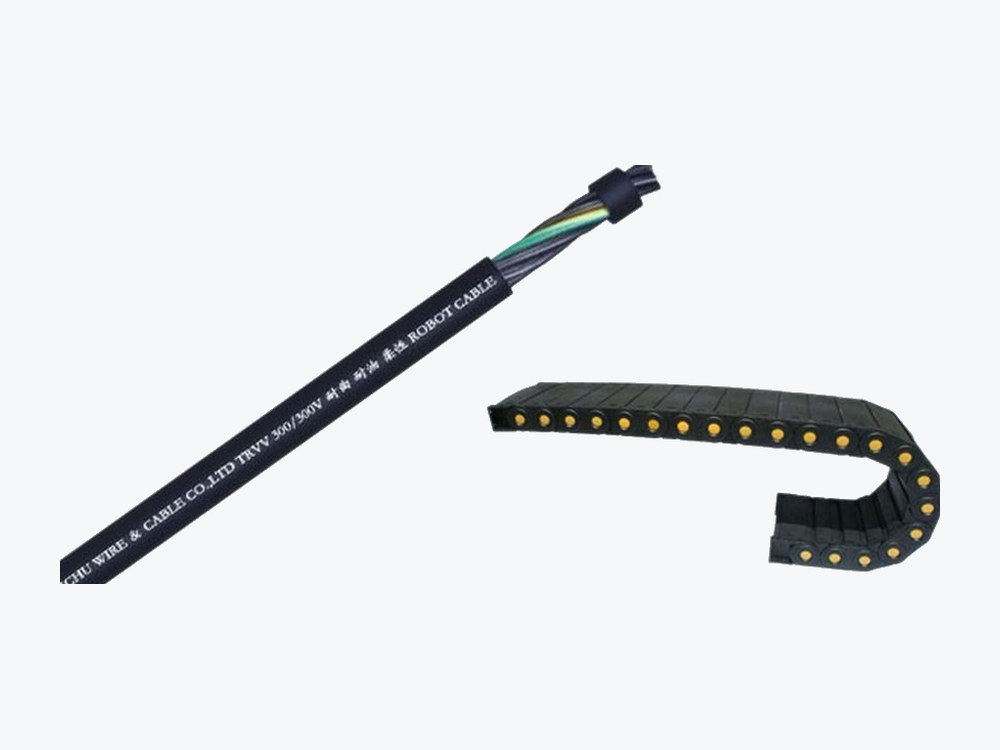
1. Start with the bend radius — it governs everything
The chain’s bend radius (R) must be at least the minimum dynamic bend radius of the largest cable inside it. For high-flex PVC drag chain cables the dynamic minimum is typically 7.5 × the cable’s outside diameter; high-flex PUR types are commonly rated in the 7.5–10 × range. Fixed (static) sections may go down to about 4 × diameter — never use the static figure inside the moving bend.
Worked example: a 12 mm cable needs a chain radius of at least 90 mm in motion. If your chain is smaller, no cable brand will survive in it — change the chain or split the run.
2. Unreel tangentially — never pull cable off the side of a reel
Drag chain cables are stranded with a defined lay direction. Pulling a cable sideways off a stationary reel — or uncoiling it in loops — winds a full twist into every metre. That stored twist later shows up as corkscrewing: the cable spirals inside the chain, rubs the side walls and breaks cores. Always unreel tangentially from a rotating reel or a dereeler, and lay the cable out straight before it goes into the chain.
3. Lay the cables loose: about 10% slack, on the neutral axis
Cables must never be installed under tension. Leave roughly 10% free length inside the chain so each cable can shift as the bend travels. Cables should run in the middle (neutral) layer of the bend — not pressed against the inner or outer radius — and be able to move freely lengthwise. A cable that is stretched tight at one end will be pulled through the bend under load on every cycle.
4. Separate by size and duty
Use the chain’s separators (dividers) to keep cables apart. Rules of thumb:
- Never let a large, heavy power cable rest on small signal cables — give each size class its own compartment.
- Keep total fill moderate: cables need room to move; as a guide, the sum of two stacked cable diameters should stay below about 1.2 × the chain’s inner height.
- Keep hydraulic and pneumatic hoses in their own compartments — they need more clearance (about 15–20%) than electric cables (about 10%).
5. Clamp both ends — firmly, without crushing
Strain-relieve every cable at both the fixed and the moving end of the chain, so movement is absorbed in the bend and not at the connector. The clamp must hold the jacket without deforming the cable’s cross-section: a crushed clamp flattens cores, changes the lay and creates a hard point exactly where bending starts. Use purpose-made drag chain strain reliefs, and leave the first section of cable after the clamp free to flex.
6. Keep power and signal apart
Drive power cables radiate interference at every switching edge. Run shielded types (TRVVP for power and control, TRVVSP for encoder and data pairs) in their own compartment, away from unshielded signal runs, and terminate shields over the full 360° at the cabinet. Separation inside the chain is the cheapest EMC measure there is.
7. Commission slowly, then re-check
After installation, run the axis through its full travel at low speed and watch the bend: cables should glide, not climb over each other or pull tight at the ends. Re-check after roughly 24 hours of operation and again after the test run — slack, clamps and separators all settle in the first day.
The mistakes that cost the most
| Installation mistake | What it causes | Fix |
|---|---|---|
| Cable pulled off the side of the reel | Corkscrewing, side-wall wear, early core breakage | Unreel tangentially; lay out straight before fitting |
| Chain radius below the cable’s dynamic minimum | Conductor fatigue, insulation cracking at the bend | R ≥ 7.5 × largest cable OD (dynamic) |
| Cable installed under tension | Cores pulled through the bend under load; connector damage | ≈10% free length inside the chain |
| No separators; mixed diameters stacked | Jacket abrasion, small cables crushed by large ones | One compartment per size class |
| Clamp crushing the jacket | Hard point at the clamp; cores break just behind it | Correct-size strain relief; free flexing section after the clamp |
| Power and encoder cables bundled together | Signal errors, drive faults | Shielded types, separate compartments, 360° shield termination |
Frequently asked questions
- How much slack should a drag chain cable have?
- About 10% free length inside the chain is the working rule. The cable must be able to move lengthwise and sit on the neutral axis of the bend without tension at either end.
- Can I mix power and signal cables in one drag chain?
- Yes, with separators between them and shielded constructions for the noisy and the sensitive circuits. Never stack a heavy power cable directly on signal cables.
- Why did my cable start corkscrewing after a few months?
- Almost always stored twist from installation — the cable was uncoiled in loops or pulled off the side of the reel. The cores try to return to their stranded shape in service. Replacing the cable and unreeling the new one tangentially solves it; no adjustment of the old cable will.
- Does a bigger bend radius always help?
- Up to a point. Beyond the rated minimum, extra radius gives diminishing returns — correct laying, separation and strain relief matter more once the minimum is met.
Fitting cables into a chain you already have?
Send us the chain’s bend radius, travel and what the cables feed — we will match constructions from our standard range (medium-speed EKM61100 to 7 million cycles, high-speed EKM71100 and PUR types above that) and quote within one working day.
EKM61100 — medium speed Open the cable selectorWhen the run also feeds drives, pair the chain with our high-flex power cable; and when a standard construction does not fit your chain, we build custom cable assemblies from 300 m.