

Elevator Travelling Cables (TVVB/YFFB): Installation & Inspection
A lift’s travelling cable hangs in the shaft and moves with the car, trip after trip — carrying control, travelling power, communication, monitoring and signal circuits while holding its own weight. This guide covers the flat travelling cables in our programme — TVVB, YFFB and YVFB, with and without the steel-wire G element — how to choose between them, the factory’s rule for when the steel wire is needed, and what to check at installation and at inspection.
1. What the travelling cable does
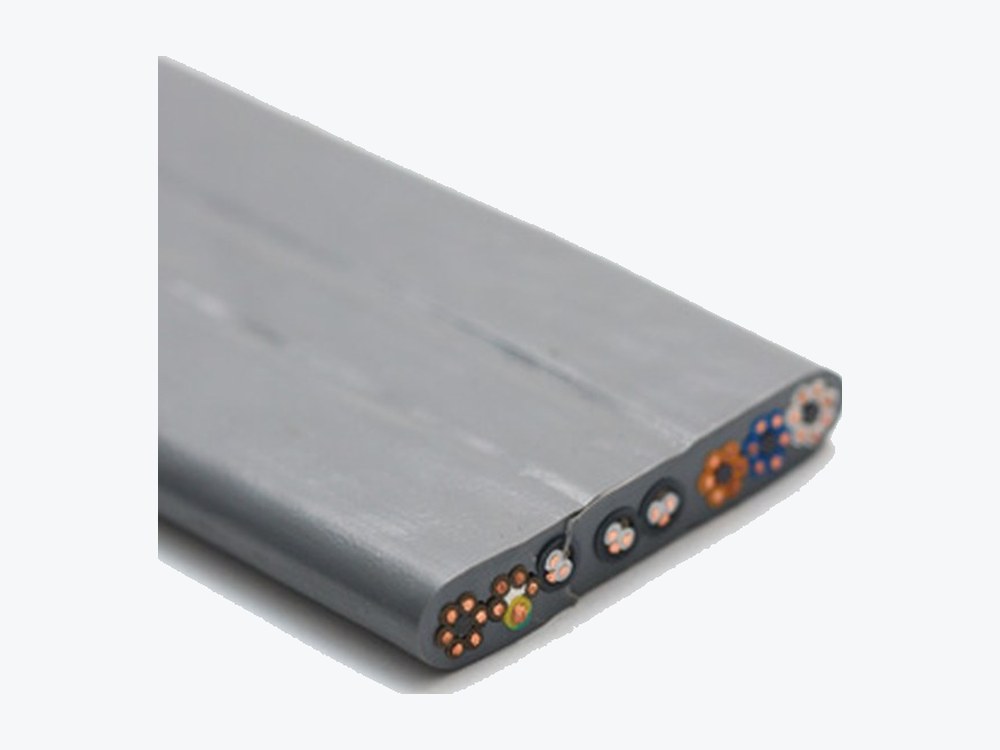
The travelling cable is the moving link between the shaft top and the car. One end is fixed at the top of the shaft, the other rides with the car, and the loop between them shortens and lengthens on every trip. It carries elevator control, travelling power supply, communication, monitoring and signal transmission — all in one flat cable — and it does so while hanging under its own weight and the mechanical stress of constant movement. That is why a travelling cable is built differently from a fixed shaft cable: the construction has to stay flexible, keep its shape in the loop, and survive its own suspension force. Our elevator travelling cable range lists more than 5,800 constructions, flat and round, with and without steel support elements.
2. The range: TVVB, YFFB and YVFB
Three flat families cover the travelling duty, each with a G version that adds a steel-wire load-bearing element. The table below is the selector count — standard rows, recomputed from our selector data.
| Family | Standard rows | Construction |
|---|---|---|
| TVVB | 315 | Flat PVC travelling cable to GB5023.6, IEC60227-6 and EN50214; cold-resistant PVC sheath, stays flexible at −15 °C; 0.5–95 mm², 2–66 cores |
| TVVBG | 282 | TVVB with steel-wire load-bearing element (G); same 0.5–95 mm², 2–66-core grid |
| YFFB | 632 | Flat travelling cable with oil-resistant flexible rubber sheath, stays flexible at −15 °C, flame retardant; 0.75–240 mm², 2–66 cores; also used as a crane festoon cable |
| YFFBG | 580 | YFFB with steel-wire load-bearing element (G); 0.75–240 mm², 2–60 cores |
| YVFB | 632 | Flat travelling cable on the same 0.75–240 mm², 2–66-core grid as YFFB |
| YVFBG | 580 | YVFB with steel-wire load-bearing element (G); 0.75–240 mm², 2–60 cores |
| TVVBPG / TVVBP | 54 | Shielded TVVB variants — braid, foil or copper-clad steel braid — with twisted-pair signal cores |
| RVV shaft cable | 74 | Round fixed shaft wiring (with and without earth core) — not a travelling cable |
| TVVB2G video | 3 | Flat video composite: coaxial video plus power cores in one travelling cable |
Travelling-cable rows in the selector total 3,152. The YFFB and YVFB counts include both GB-standard and full-section variants. The model code itself tells the story — TVVBPG-TV decodes as T for elevator, V for PVC insulation, V for PVC sheath, B for flat, P for shield and G for steel-wire reinforcement.
3. When the steel wire (G) is needed
Whether a travelling cable needs its steel-wire load-bearing element is decided by two numbers: the free length and the running speed. The factory rule is the same for TVVB and YFFB:
| Arrangement | Add a load-bearing element when | Element |
|---|---|---|
| Flat, single-row | Free length over 35 m, or running speed over 1.6 m/s | Galvanised soft steel wire rope, or aramid fibre rope |
| Plum-blossom bundled | Free suspension length over 80 m, or running speed 4.0–10.0 m/s | Galvanised soft steel wire rope |
Below those limits the standard construction carries itself. Above them, the steel wire — not the copper cores — must take the suspension load, and the wire has to be terminated properly at both ends. That is the whole point of the G versions: the same flat cable, with the load taken off the cores. High-strength aviation galvanised steel wire is the reinforcement the factory uses, and it is what extends the service life on long suspensions.
4. Worked rows: reading a selector line
Every selector row carries a stock code, the model, the construction and the outer dimensions — flat cables are given as width × thickness — plus the weight. Eight real rows:
| Stock code | Model | Construction | Outer dimensions | Weight |
|---|---|---|---|---|
| K102010005010 | TVVB | 0.5×10C | 25.2×4.1 mm | 193 kg/km |
| K102010007510 | TVVB | 0.75×10C | 28.8×4.2 mm | 252 kg/km |
| K102010025012 | TVVB | 2.5×12C | 48.5×5.7 mm | 678 kg/km |
| K102010950005 | TVVB | 95×5C | 101.0×21.6 mm | 6,168 kg/km |
| K102060007510 | YFFB | 0.75×10C | 28.8×4.6 mm | 254 kg/km |
| K102080007510 | YFFBG | 0.75×10C | 34.3×4.6 mm | 301 kg/km |
| K102040082400804B | TVVBPG | 24×0.75+2×2P×0.75 (copper braid) | 53.3×8.4 mm | 858 kg/km |
| K1020500002 | TVVB2G video | 75-5+2×0.75 | 22.9×9.3 mm | 340 kg/km |
Note how the G version of the same construction runs wider and heavier — compare the YFFB and YFFBG 0.75×10C rows — because the steel wire sits inside the flat profile. And note the shielded row: the twisted pairs (2P) are signal cores inside the power cable, so one travelling cable can carry control and signal together.
5. Installation: hang it right
- Fix both ends, load the wire: clamp the cable at the shaft top and at the car, and terminate the steel-wire element so it — not the copper cores — carries the hanging weight.
- Let the loop hang free: the loop must move through the full travel without catching on brackets, guide rails or shaft equipment, and without being pulled taut at either end of the travel.
- Bend it in its own plane: a flat cable bends in one plane only. Never twist it sideways or force it around a corner it was not laid for — a twist in the loop becomes a permanent kink.
- Keep the flat side flat: in a plum-blossom bundle, keep the bundle as laid; do not let individual cables cross over each other in the loop.
- Do not splice in the loop: joints belong at the fixed ends. A splice in the moving loop is a weak point that flexes on every trip.
- Do not add weight: nothing hangs from a travelling cable — no clips, no extra cables, no cable ties pulling it off its line.
6. Inspection: what to check, and when to replace
- Sheath: look along the whole loop for cuts, abrasion and flattening. A cut that reaches the cores is a replacement, not a repair.
- Twist: sight down the loop — a cable that no longer hangs straight, or that corkscrews, has taken a permanent set and should come out.
- Fixings: check both end clamps and the steel-wire terminations for slip, corrosion and loose hardware.
- Loop behaviour: run the car through its full travel and watch the loop: it should swing freely and return to the same shape every time.
- Signal cores: if the installation carries video or signal pairs, check the picture and the signal at the same time as the sheath — intermittent faults that come and go with car position usually live in the loop.
- Replace, don’t patch: a travelling cable that has been cut, kinked or twisted has lost the construction that made it a travelling cable. Replace the run; do not tape over it and hope.
7. What to send for a quote
- Travel height and free length: the free hanging length decides whether the G version is needed.
- Running speed: car speed, in m/s — the second half of the G decision.
- Arrangement: flat single-row, or plum-blossom bundled.
- Cores and cross-section: how many cores, and what each one carries — power, control, signal, video.
- Shielded or video: say so if signal pairs or a camera feed ride in the same cable — TVVBPG/TVVBP and the TVVB2G video composite exist for exactly that.
- Length and quantity: custom builds start at 300 m. The flat travelling cable YFFB / YFFBG shows the construction, and the cable selector lists every standard row.
- TVVB or YFFB — which one do I need?
- Both are flat travelling cables. TVVB is the PVC-sheathed travelling cable to GB5023.6, IEC60227-6 and EN50214, with a cold-resistant PVC sheath that stays flexible at −15 °C. YFFB is the oil-resistant flexible rubber-sheathed flat cable, also flexible at −15 °C and flame retardant, and it doubles as a crane festoon cable. Pick by sheath and by what the lift specification calls for — the travelling duty is the same.
- When is the G (steel-wire) version needed?
- When the free length or the speed passes the factory limits: over 35 m free length or over 1.6 m/s in a flat single-row arrangement, and over 80 m free suspension length or 4.0–10.0 m/s in a plum-blossom bundle. Below those limits the standard construction carries itself.
- Can one cable carry video as well as power?
- Yes — the TVVB2G video composite carries a coaxial video feed plus power cores in one flat travelling cable, and the shielded TVVBPG/TVVBP variants carry twisted-pair signal cores alongside the power cores.
- What is the RVV shaft cable, then?
- Fixed shaft wiring. The RVV elevator shaft cable is round, fixed in the shaft, and never travels with the car — it is the companion to the travelling cable, not a substitute for it.
- What if my lift needs a construction that is not in the selector?
- Send the travel height, speed, arrangement, cores and any signal or video requirement. Custom builds start at 300 m, and we quote usually within one working day.
Send the travel height, the speed and the cores
Send the free length, the car speed, the arrangement and the cores you need. We will confirm the construction — including whether the G version is needed — and quote usually within one working day.
Cable Selector WhatsApp Request a Quote